ECMS holds roundtable on futureproofing change and transformation in insurance
 by Estelle James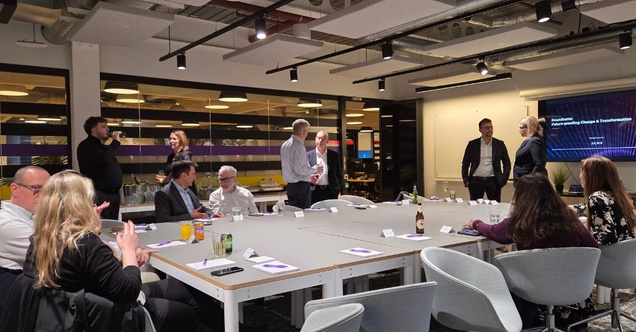
ECMS hosted a change and transformation forum in our London office on Thursday 26th February., where we were joined by change leaders from top-tier insurance companies to discuss futureproofing change and transformation. The conversation centred on how the insurance industry’s approach to change differs from the rest of financial services; transformation stories and lessons; and how AI and automation are reshaping transformation delivery. Here are some of my key takeaways from the roundtable.
‘Hearts and minds’ still the focus
A successful tech transformation with a poor adoption is an unsuccessful transformation, no matter how slick the tech. Winning the hearts and minds of the business is a critical element of any transformation. To recognise this, more and more insurers are training their senior executive leadership, and the next level down, on the art of change. The purpose of this is teaching a change framework, what to expect and how to navigate a change programme, so that all stakeholders are aligned on what a change programme needs to look like and how they need to be involved. By empowering change at these levels, hearts and minds are more effectively captured.
Resourcing will always be bespoke
When it comes to resourcing change programmes, there was a consensus that there is no ‘one size fits all’ resource model. Organisations therefore continue to rely on external partners as they can’t carry a 1000 person change and transformation function, or permanently hold a team with the variety of different skills required. A data platform programme, for example, has its own unique needs, such as large volumes of data engineers, analysts and architects. If the same company, the next year, were to embark on a broker system implementation, the resourcing needs would entirely change. This reality of the change environment means a permanent model won’t work. That’s where organisations can benefit from partnering with a company like ECMS to scale efficiently and effectively in providing bespoke change solutions.
Use of AI is still quite basic
Our attendees’ businesses are generally using AI on an ad hoc basis to improve people’s ability to perform certain tasks. With the majority writing emails with Copilot and correcting their stories with ChatGPT, AI is currently a process improvement tool rather than the transformation tool it should be.
However, other insurers are making faster progress. Some organisations are experimenting with evolutionary swarm coding, with specialised AI agents able to build complex software overnight and remove the need for a call centre of thousands of people. Organisations who can leverage AI as a transformation tool are the ones that will win in the end. Those who still see it as simply a productivity enhancer will get left behind.
Maturing governance requires a strong feedback loop
Our attendees felt regulation in insurance is not as prescriptive as in other financial services industries. As such, we discussed the importance of putting in place the right framework to learn lessons and adapt, with governance functions often not as prevalent. In insurance, there’s a feeling that organisations often outsource a lot of their change work and spend a lot of money doing it, without the same level of accountability. We compared this approach to our attendees’ experiences in other financial services, where you know when a programme is going off the rails because it is being more actively measured throughout. The insurance industry is going through a maturing process for how it manages outsourced teams, ensuring progress, performance and return on investment. It is up to companies to ensure that their change programmes have sufficient governance around them to realise real benefits and ROI.
Conclusion: evolving change will evolve your organisation
For change management to be a success, it needs clear use cases, a strong governance culture, a basic way of tracking ROI and the right accountability. The way the insurance industry has structured programmes to date has left some room for improvement, but by bringing change leaders together to discuss challenges, successes and best practice, we can make significant inroads into futureproofing our organisations in general, and our change functions in particular.
Many thanks to everyone who joined us for the discussion and we’ll be sharing more detailed insights in the near future. In the meantime, if you’d like to talk to me about how you can futureproof your change function or would like to find out more about our next roundtable discussion, please get in touch now.
Fresh Content
Explore our latest market insights, career advice, and more.